
Half-Cut Cell Technology Explained
Date: October 2025
Author: Macire Energy Team
Category: Solar & Energy Solutions
☀️ Introduction: Power from Every Cell
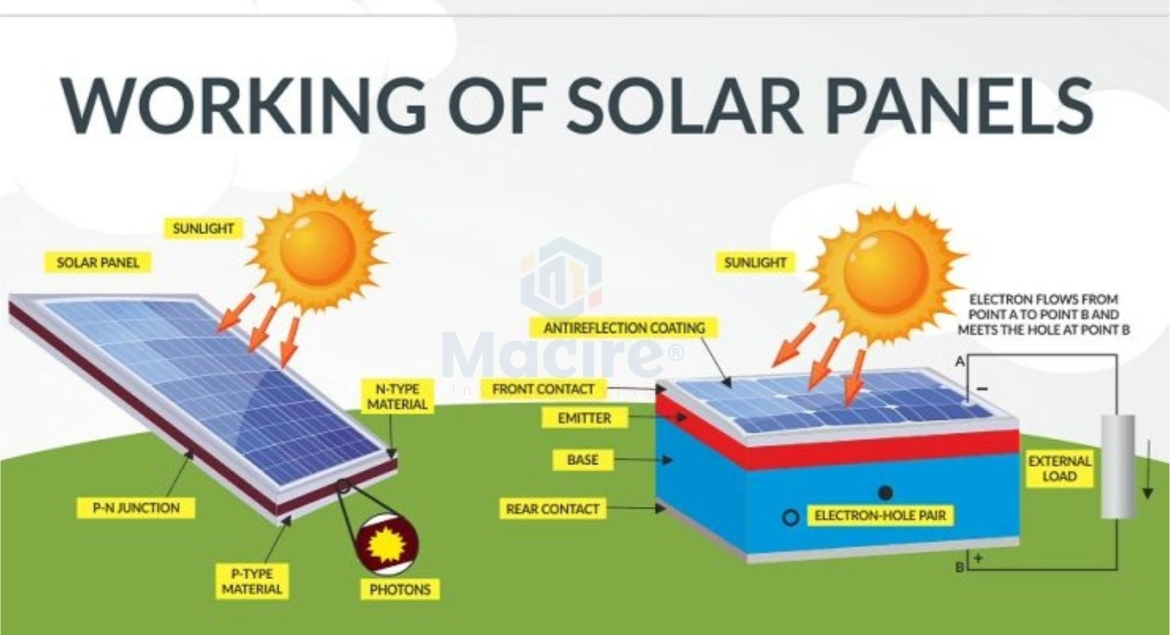
Ever wondered how a single solar panel — like a 500-watt SolarEon monocrystalline module — produces so much power from thin blue cells?
Let’s break down the simple but fascinating science that converts sunlight into usable energy.
⚡ 1. Every Cell is a Tiny Generator
Each solar cell is a small power plant.
When sunlight hits it, electrons move — generating voltage (V) and current (A).
A modern 182mm monocrystalline cell (often called M10) typically produces:
- Voltage: around 0.6 volts
- Current: about 13–14 amps
On its own, that’s not much — but when you connect many cells together, magic happens.
???? 2. Series Connections Build Voltage
When cells are connected in series, their voltages add up, while current remains the same.
Example:
1 cell = 0.6 V
60 cells in series = 60 × 0.6 = 36 volts
That’s why most modern panels, including the 500-watt SolarEon model, list:
- Voltage at max power (Vmp) ≈ 36.6 V
✂️ 3. Why Modern Panels Use Half-Cut Cell Technology
If you’ve looked closely at new panels, you’ll notice 120 small rectangles instead of 60 big squares.
Those are half-cut cells — each standard cell is cut in half to reduce electrical resistance and heat buildup.
Here’s what that means:
- The panel still behaves like a 60-cell design
- But each half carries half the current, reducing power loss
- It’s wired as two 60-cell strings in parallel — same voltage, better efficiency
✅ Result: More power output, less heat, better performance in partial shade.
⚙️ 4. The Real Math: Voltage × Current = Power
From the SolarEon 500W nameplate:
| Parameter | Symbol | Value |
|---|---|---|
| Voltage at Max Power | Vmp | 36.6 V |
| Current at Max Power | Imp | 13.67 A |
| Rated Power | Pmax | 36.6 × 13.67 = ≈ 500 W |
That’s how the 120 half-cut cells combine to deliver 500 watts under standard sunlight (1,000 W/m² at 25°C).
???? 5. Advantages of Half-Cut Panels
| Benefit | Explanation |
|---|---|
| ⚡ Higher Efficiency | Lower internal losses and higher energy yield |
| ???? Better Shade Tolerance | Each half operates independently |
| ???? Higher Power Density | More watts per square meter |
| ???? Cooler Operation | Less resistance = less heat buildup |
| ???? Longer Lifespan | Lower stress on each cell = slower degradation |
???? 6. Quick Recap Formula
Panel Power (W)=Cell Voltage (V)×Cell Current (A)×Number of Cells in Series\text{Panel Power (W)} = \text{Cell Voltage (V)} × \text{Cell Current (A)} × \text{Number of Cells in Series}Panel Power (W)=Cell Voltage (V)×Cell Current (A)×Number of Cells in Series
For this 500W module: 0.61V×13.7A×60=≈500W0.61V × 13.7A × 60 = ≈ 500W0.61V×13.7A×60=≈500W
???? Final Thoughts
Today’s 500-watt solar panels are engineering masterpieces — combining 60 full monocrystalline cells (120 half-cut), smart wiring, and clean design to achieve high power output and reliability.
At Macire, we believe knowledge builds confidence.
Understanding how your solar panels work helps you choose better, install smarter, and maintain your systems for maximum lifespan.
???? Macire – Inspired Living
Power • Water • Machinery • Sustainability
???? Visit: www.macire.co.ke
???? Call/WhatsApp: +254 713 520 969